
Turning Knowlege into Practice - Nature Assisted Pasture Construction
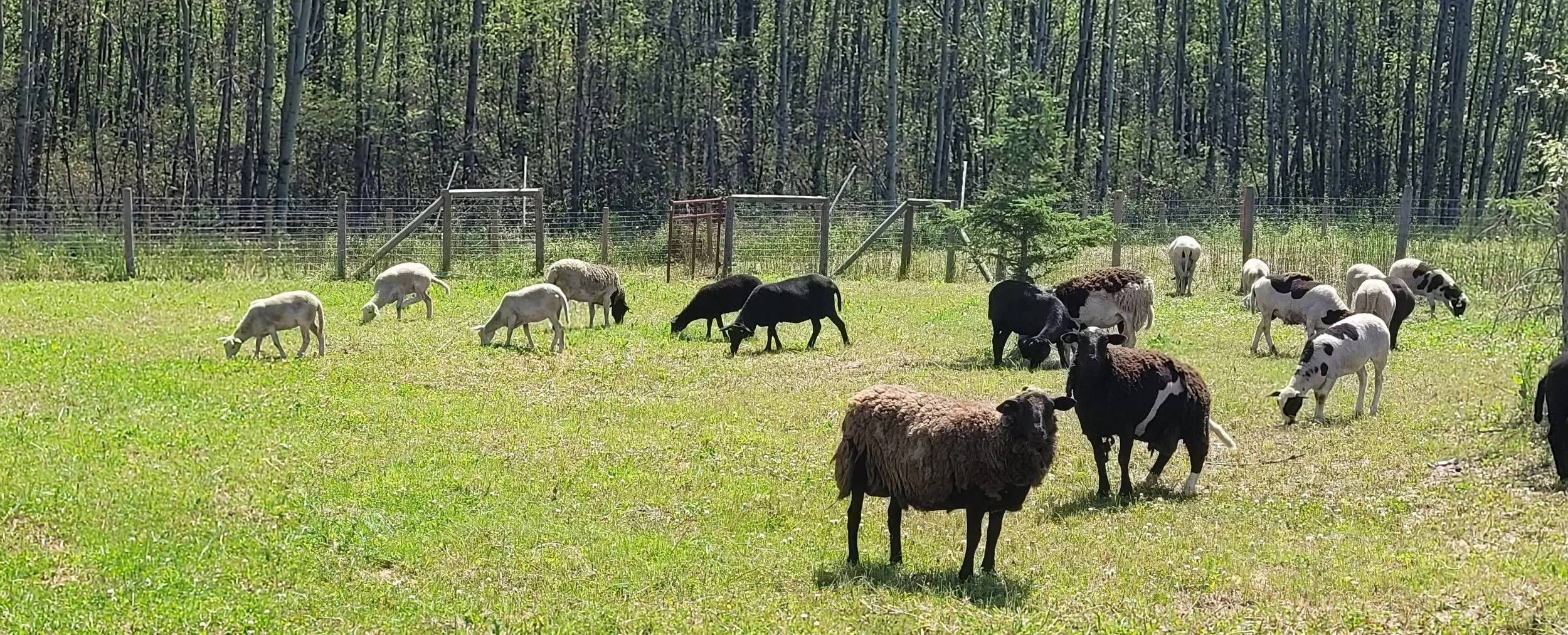
Using sheep as a tool to accelerate the movement from bare bround to healthy grass.
As we did some extensive land clearing on the farm, to open the space, and to provide more grazing along with the facilitating the building of amenities around horse and dog workshops, I have the opportunity to document and share some ideas and put them into practice. The enclosure in the accompanying photo was cleared one and a half years ago and subsequently fenced. It is primarily an addition to the back yard space, and somewhere to safely keep the dogs confined so that they do not get entangled with the abundant wildlife in this area.
Because I am a permaculture and regenerative farming nerd, I am trying to stack enterprises for maximum return, and expand diversity for the overall health of the lands ecosystem to build resilience …and save my pocketbook. As the area is slated primarily to be a grassed dog yard it will also eventually supplement feeding sheep and in turn horses. Mostly fossil fuel free mowing and weed control with the occasional touch up with the lawn mower.
The ground was mostly bare last year and had no, to some small patchy areas, of thin soil. It is very expensive purchase and to truck top soil to this location, so I had to get creative and come up with an alternative solution. My ultimate goal is to have a multipurpose grassed area and to implement what I have been learning.
As there is no soil, the grass seeds will simply not germinate in the sandy clay, dirt base. It is a waste of seed and will bear limited results (grass seed is also expensive). This has been my opportunity to make friends with weeds and to actually watch natural succession in progress, accelerated a little with the help of a human.
The only thing that will grow reliably in this poor, mostly inorganic dirt and patchy soil are what we call weeds. We have often been taught that these are the enemy and that we need to chemically be rid of them. Let us look at what nature would do.
What we call weeds, often annuals that are quick growing, go to seed, spread and multiply at astonishing rates. The only reason that they have the ability to multiply like this is that the conditions are favorable for them to germinate and flourish.
Weeds have jobs to do. In nature, disturbed ground, be it by fire, landslide, overgrazing etc, will be colonized by weeds. Think of them as a Band-Aid or a scab analogous to a healing wound. If this is removed over and over, the wound will heal slowly or not at all. The ground is being “healed” into a self organized system of abundance.
Often these disturbed areas are highly compacted and devoid of soil life and therefore are not appropriate habitats for forage grasses. Dirt is the inorganic substrate of soil, and soil can be seen as a necessary, organic, living and life giving substrate on which all living beings that we are and see depend. It is non-negotiable! With the aid of sunlight and photosynthesis, weeds will start this cycle of converting dirt into precious this soil.
There are an abundant variety of weeds, each doing varying jobs. Some have large, strong tap roots, penetrating and breaking compacted ground, cycling minerals up from the deep, and some form close relationships with bacteria that can harness nitrogen from the atmosphere…Ultimately; there are as many different weeds as there are services for them to perform.
Nature hates bare ground and will always try and cover it to kick start a complex structure of life. If ground is bare, most organisms will not survive as like us, they will be too hot, too cold, too we, too dry as they require specific temperatures, oxygen and water levels and food to flourish and to do their jobs.
The weeds initially colonize the “dirt” and will begin to produce complex sugars and simple proteins that they will exude out of the root systems that they lay down. This will feed specific microbes that will in turn start a cycling of nutrients at the root zone and make it inhabitable for invisible life. In this trading relationship the plants will swap the sugary plant nectars excreted through their root systems, for water, minerals and for protection, while symbiotically the microbes build synergistic networks around the roots where they find this food. When we spray these plants with chemicals, we not starve these organisms by cutting off their food supply, but indiscriminately chemically annihilate them. These organisms are required to build underground water reservoirs for excessive rain, storing it for future plant use and they free up and cycle nutrients from inorganic to plant, and ultimately animal and human availability.
So now we get to our step two, as having let the ground be colonized by these “weeds” we began to mow them. By dropping their biomass by mowing, it provides building materials for the microbes to begin to build complex soil structures. They are integrating this organic carbon material, eating it, pooping it, tunnelling through, and rearranging pieces, sequestering carbon and makings soil. There is an army building beneath your feet.
This year, after mowing, I decided you use some macroscopic helpers and am adding sheep to the system. Sheep will accelerate this even faster. Their tiny cloven hooves will press the mow clippings and trampled plants into the soil where the microbes will gain further access as they are recycled into the soil system building biomass. The sheep love many of the plants that are growing there and that we find undesirable and that our horses refuse to eat or even sometimes find toxic. They dutifully chomp away on these buffets of sheepy favorites and as they mow this “lawn” in a more natural fashion, they will also be inoculating the soil with more microbes. The land desires the presence of ruminants like sheep. Their saliva, urine and poop are all loaded with microbe feeding goodness. The bacteria growing in the fermentation chambers of the sheep’s rumen will further add to the soil building crew invisible to our unaided eyes.
Yes the lawn area is still weedy, it is however now green; clean shorn, tidy and a building ecosystem. As the soil begins to build beneath the weeds, the environment will become more conducive to the survival of grass, and the weeds will naturally find it inhospitable and disappear as the ecological system shifts away from them. The next step will be to begin adding a bit of pasture seed maybe next spring and begin the grass cycle. I anticipate that within a few short years, I will have a nice lawn along with free topsoil, and a little more free sheep and horse grazing.