
There’s a “BLEEPING” Goat in the Yard!!!
A Real Life Case Study
One of our friends, followers and clients has taken pasture management to another level. We were delighted to see that Sandy began bale grazing her little herd of horses on her small acreage/hobby farm to help realize better soils, more water holding capacity and the many more side effects resulting from following a permaculture/ regenerative system of land husbandry. The area in which she lives is experencing frequently drier summers leading to shortages and increasing prices in forages available for her horses. Livestock, including horses, if managed well, can be used as a great tool for managing and improving pastures. If you have these critters, why not use them and get something extra back from your continuous investment. Careful and educated grazing practices, not only will counteract expensive hay prices and shortages, but will also result in increased nutrition and health for her land AND her animals. This again will have her pocket book sighing with releif as she spends less on costly suppliments and veterinary care. It is good to remember that nature works in intricate cohorts where everyone has a job and contributes to the health and wellbeing of the entire system. Permaculture and regenerative agriculture shows us how to follow nature’s lead and adding diversity will only benefit the whole.
We love it when we realize that people, although breaking from mainstream ideas, are actually quietly listening and willing. In 2026, Sandy has experimented with these concepts, tried things out for herself and has added a few goats to her pasture management plan. Yes, goats are not for everyone, but they do tend to knock back more “weed species” plants than do their fellow grazing pals such as cows or sheep. Different species of grazers occupy different niches and tend to eat different plants. This means that you are actually getting more out of your pastures, all the while improving them if done intelligently. Controlling weeds that are unpalatable to horses is essential. If not managed, they will go to seed and spread, while palatable species will be overgrazed and eventually die back. We can see the results in almost every pasture where only one species of grazer is allowed to continuously graze. Contrary to strong advertisements, chemical spraying is not optimum as it is toxic to you, your animals and your soil organisms putting your system into an infinite negative spiral. It is expensive and will not result in a long term solution as you find yourself in a perpetual loop of reapplication. Mowing is labor intensive and requires expensive equipment and fossil fuels, so why not ask a ruminant to help?
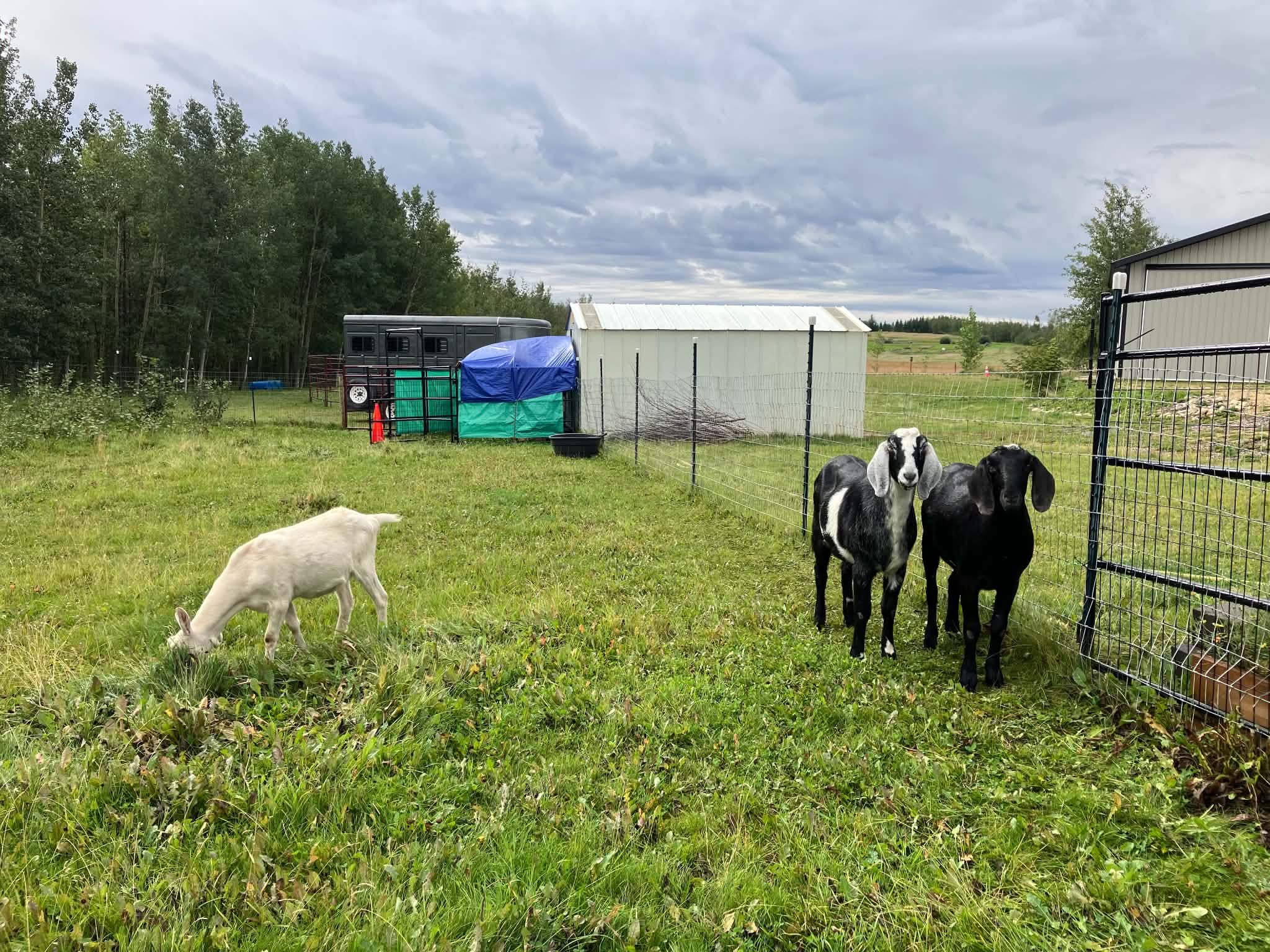
The three musketeers form the “Goat Gang”: Gilderoy, Severus, and Draco
There are ways in which you can add valuable ruminants to your system without having to nessicarily have to own them. The collaborative opportunities are limited only by your imagination and willingness to ask around.
Being creative, Sandy had a friend who owned a few goats and simply borrowed them for a few weeks to do a job. This is a great community building win-win endeavor as the borrower realizes free weed control, and the lender gets access to a free, diverse forage source for their stock. Knowing goats, the loaner may also enjoy the occasional wee break from them.
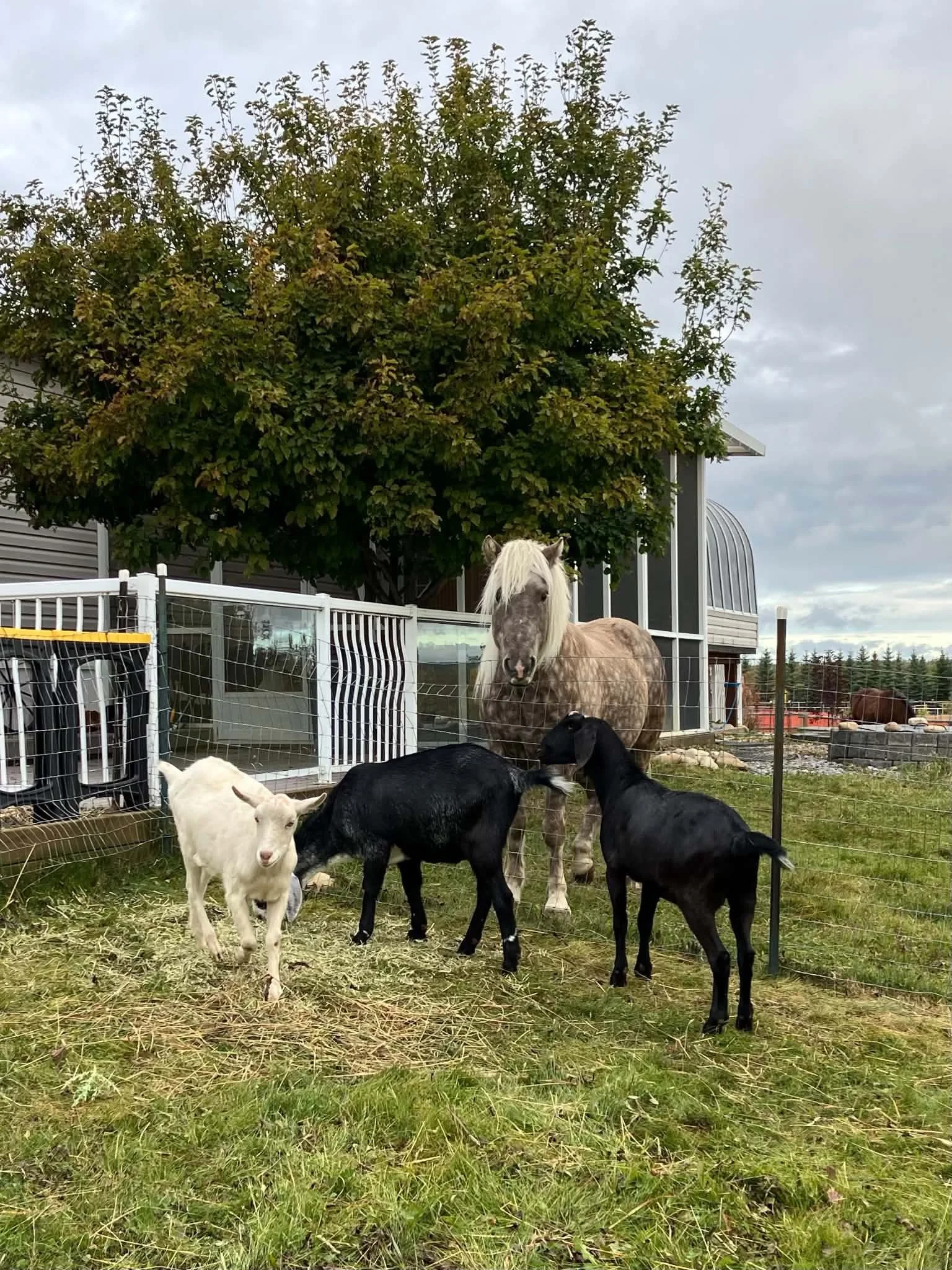
Lagsi, the intrepid, resident Icelandic horse makes new friends
We sat with Sandy and asked her a few questions about her real world experience and here is her synopsis of the experiment in her own words:
QF: Did you purchase, lease, or borrow your goats?
Sandy: I borrowed the Goat Gang (GG) of wethers (castrated male goats) from a friend, Kelly McCrea, who raised them since they were a few months old. They were easy to care for, once I learned the details from Kelly. They were awesomely pleasant to have around, and I enjoyed their antics and little bleats of greeting.
QF: How many goats did you run and for how long?
Sandy: Gilderoy, Severus, and Draco came to live with us for two and a half weeks as a trial run of having goats in the yard. I knew very little about goats prior to this, but I did admire how they were employed in other landscaping situations.
QF: How did they integrate with your horses?
Sandy: The GG were a few years old and well socialized with people, horses, dogs, and cats. One of my horses felt they were monsters and wouldn’t even look at them. My other horses were curious, then accepting. For this pilot project, the horses were separate from the GG, though they could socialize through and over a fence.
QF: Did you target areas and specific plants, or rotationally graze them?
Sandy: I’m curious about, and motivated to, adopt regenerative practices for my acreage (small, 8 acre hobby farm). After two years of no herbicides or pesticides at my place, and good rain, aspen and poplar trees began to appear where there were none before. I wanted to try goats in one small paddock of about 1/3 acre to thin the baby aspens, clean up the brush between larger trees at the back, and eat down “weeds” and grass. The soil is of poor quality in that area, so goats could fertilize and dig as they go.
QF: How did you keep them contained?
Sandy: The goats grazed as they wished within the paddock, which was already enclosed with four-foot no-climb field fencing and gates. It seemed like the best safe place for a beginner like me. A shelter for them was built in a couple of hours with materials already on hand. It was surrounded by a fence of no-
climb panels with a gate that could be closed at night if the local coyote pack seemed active.
QF: How much extra work did they produce vs how much savings in work and resources did they
contribute?
Sandy: In two weeks, the GG probably saved me up to 30 hours of labour (and a sore back), and possibly more. They knew how to do a better job than what I could have done. The extra work on my part was minimal– fill their water, top up their baking soda and salt pans, and check on them at least twice a day when I did my horse checks. Additionally, I did pick up then return the goats in my horse trailer.
QF: Is this something you will repeat, and if so, why?
Sandy: I already have agreement to borrow the GG next year for longer. Once I “goat proof” an adjacent area of about 3/4 acre, they can do their work in both areas. (By goat proof, I mean move a few things that may not be goat friendly. It’s already field fenced too.) They’ll again save me a lot of time and improve the soil conditions in ways that seem much better than I could do easily without great physical effort and expense.
Why weed-whack or mow if I don’t have to? The GG could complement how I try to have the horse occasionally graze small areas. Actually, I think the GG are better than the horses at “landscaping” because they didn’t seem to preferentially overgraze patches.
In subsequent years, I might invest in portable electric net fencing and small solar charger. Then there’seven more possibilities for goat-powered weed-whacking.
QF: What was the number one thing you felt that you did well?
Sandy: It went well to go slow and small for the trial of goats in the yard. I could learn about goats, their daily self-developed routines, and how they interact with the environment. The trial was low pressure for a first-time goat herder.
QF: What was the number one thing that you would do differently next year?
Sandy: Next year, a more permanent shelter could be built for the GG. I’m not sure the temporary structure with a tarp roof and sides would have held up to a big storm.
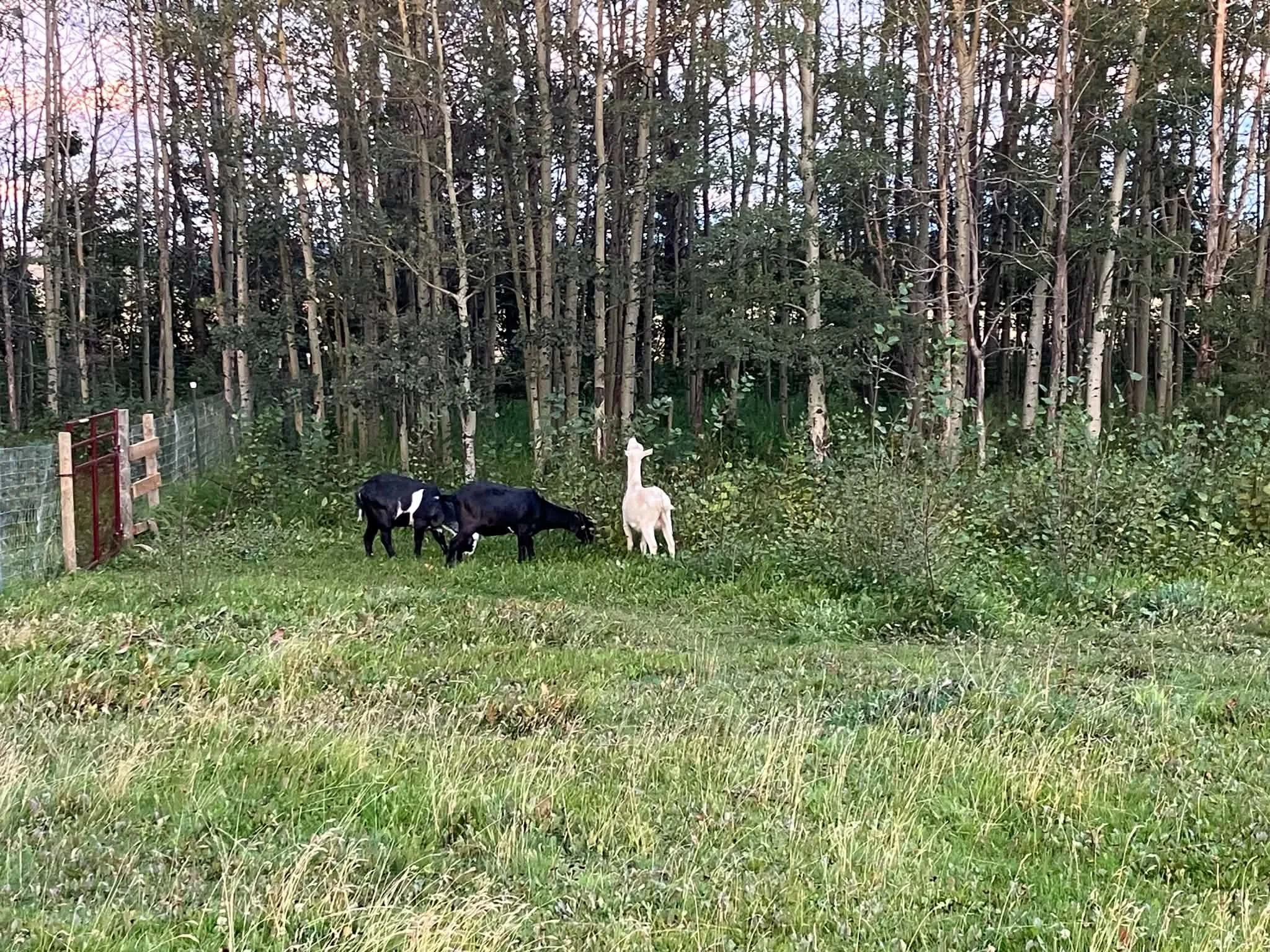
Labor saving helpers browsing and cleaning a forest lot, Along with tidying, cleaning out and fertalizing the understory, it also will increase fire saftey.
Final thoughts form Sandy on her experience
“I was anxious starting out this trial because of my lack of knowledge, then as my confidence grew, it became a pleasant and useful experience. If I had to purchase goats for this experiment, I wouldn’t have tried it. Thank you, Kelly! Thank you, Gilderoy, Severus, and Draco! Would I buy my own goats? I’m not certain, though I’m inclined to answer, no. In our winters, they require a much more comfortable space to stay warm, heated water, proper nutrition, and other care. For me at least, it seems to be more resource efficient and effective to borrow or rent these amazing contributors to regenerative farm practices.”
This conversation highlights an easy possibility for adding biodiversity and to increase the health and productivity of your land, no matter how small, are proven here by Sandy’s overwhelmingly positive experience and willingness to think outside the box to try something new.
As you can see in this article, to find success, you do not have to own the animals, and it is prudent to start small as did Sandy, so to not overwhelm yourself as you are learning about, and adapting to a new thing.